Updated August 5, 2025 11:12AM
How to Choose the Best Carabiner
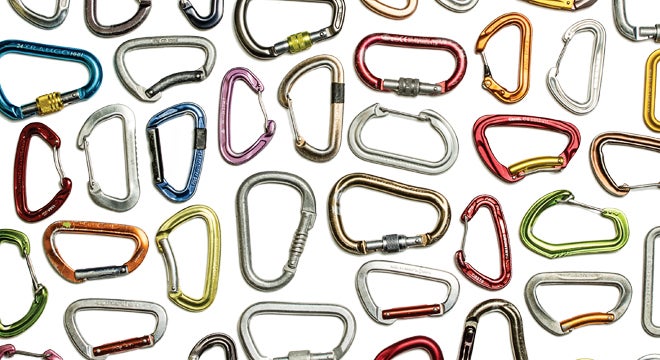
"The Carabiner Handbook"
Right behind chalk and puffy jackets (okay, ropes, too), carabiners are the most essential piece of climbing gear. These small metal clippers are the staple of any rack. They’re also the icon by which non-climbers often identify our sport. The carabiner started out as a simple concept: a metal oval with a spring-loaded gate. But the intended uses, designs, and details of the carabiner have grown exponentially from their original purpose. Wondering which carabiner to buy? Below, we outline the history of the carabiner, different types of carabiners, and more so you can figure out which carabiner to buy for your climbing objectives.
Watch pro climber and guide Genevive Walker break down the ins and outs of carabiners
Which carabiner shape should buy?
There are a handful of carabiner shapes, each with its advantages and disadvantages:
- The most common is the D-shape with a completely straight spine and a sharp bend at both ends. This cuts down on weight but increases strength.
- The oval carabiner is symmetrical and more of an old-school shape. These are typically cheaper and very durable, but heavier and slightly weaker (though still fully certified).
- Pear-shaped carabiners have a spine that bends outward to form an even bigger and more curved rope basket. These are great as belay carabiners, especially if belaying with a Munter hitch or tube-style belay device. The sizable basket prevents twists and kinks in the rope. Larger and heavier, choose pear-shaped carabiners for a single belay or for anchors.
Key carabiner terms
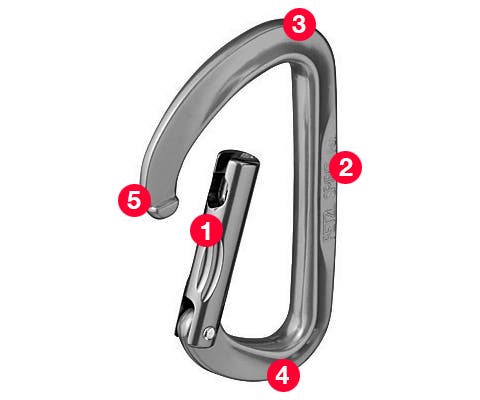
1. Gate: The spring-loaded pivoting piece opposite the spine. The gate swings shut to close against the nose.
Standard gate: A solid tube shape (pictured above). Slightly heavier with more gate flutter due to increased mass.
Wire gate: Typically a U-shape that hooks onto the nose. While it’s lighter weight, it’s slightly less durable.
Straight vs. bent gate: A straight gate runs in a continuous straight line, while a bent gate has a slight angle in it. The former is usually reserved for clipping to a bolt or a piece of gear, while bent carabiners receive a rope more smoothly.
Double gate: Also called twin gate, a double gate features two sets of rivets and two gates that open opposite each other, acting as a sort of locking mechanism.
ADVERTISEMENT
2. Spine: The long section of the carabiner opposite the gate that usually has the strength ratings, certifications, and brand stamped on it.
When a carabiner is loaded, the spine absorbs most of the force. This is the strongest individual section of a carabiner.
3. Rope basket: The large bend at the top of the spine that the rope runs through. This open curve minimizes wear on the rope and the carabiner.
4. Runner end: The smaller bend opposite the rope basket where a runner would sit. The rope, belay device, and other gear can also occupy this space.
5. Nose: At the top of the opening for the gate, the nose is where the gate latches while closed.
Some noses are notched to accept wire gates, but the keylock style is smooth, preventing carabiners from snagging on bolts and gear when cleaning.
Types of locking mechanisms on carabiner gates
A mechanism on the gate prevents locking carabiners from accidentally opening. Lockers are required in certain situations, such as belaying and clipping in directly to the anchor. There are several types of locking mechanisms:
- Screw: The gate is threaded and a metal cylinder manually spins up to cover the nose, locking it closed.
- Twist: The gate is sheathed in a spring-loaded cylinder that only opens when twisted into a certain position. These automatically lock when the gate shuts.
- Magnetic: Magnets on either side of the nose keep metal prongs against the nose, which mechanically prevent the gate from opening. Pinch the sides of the gate to lift the prongs away from the nose and open it.
ADVERTISEMENT
The making of a carabiner
All carabiners begin their lives as a tube of extruded aluminum alloy called rod stock. Aluminum is naturally lightweight and pliable for easy forming. Manufacturers add zinc for more strength. This combination maintains full strength with scant weight. A machine bends the stock into a rough oval shape that concentrates the force onto the straight spine. A forging machine presses this shape between two dies (similar to a mold), which apply great pressure to form the final template of the carabiner. A trim press then cuts away the excess metal.
These rough, gray carabiners are then heated again to strengthen the alloy in its new shape. Once cooled in water, the carabiners move through vibrating drums and tumble with wet stones to remove any unwanted texture or rough edges that could damage ropes and webbing. After being polished in another drum, some of the carabiners get painted and all get gates.
ADVERTISEMENT
Finally, every carabiner is tested for gate function. A machine pulls along the length of the carabiner, simulating the load of a 200-pound climber, while simultaneously opening and closing the gate to ensure the carabiner does not fail. Quality control selects samples from each batch for more rigorous testing. The remaining carabiners receive stamps with codes, certifications, and brand logos.
Testing carabiners
The quality control lab is basically a carabiner torture chamber, full of devices and machines designed to test them in many load and stress scenarios. Tensile testers slowly pull the carabiners until they fail: Carabiners must withstand a minimum of 20kN (4,900 lbs.) along the major axis (gate closed), and 7kN (1,500 lbs.) both along the minor axis and along the major axis with the gate open.
Unique drop-tower setups test other scenarios, like loading a carabiner over a rock edge. Manufacturers also test how a worn carabiner surface interacts with the rope, or how back-clipped carabiners perform during a fall. Variables can be adjusted to simulate dynamic and static belays. Cycle devices test gate function after 10,000-plus gate openings and closings. While those base-level strength ratings are more than enough for standard climbing uses, companies use benchmark manufacturing statistics to ensure that more than 99% of the carabiners produced are actually stronger than those numbers in real-world scenarios.
Understanding carabiner standards
A kiloNewton (kN) is the unit used to measure carabiner strength, and it can be tricky to understand in climbing scenarios because it’s not a static force. Instead, a kiloNewton meaasures mass times acceleration, or how much weight is moving multiplied by the accelerating force of gravity. For a better real-world understanding of this measurement, you can think of 1kN as approximately 225 pounds.
ADVERTISEMENT
The major axis is the long side of the carabiner, which runs parallel to the spine. The minor axis runs perpendicular to that. The strongest orientation is always along the major axis with the gate closed. Applying force on the minor axis—known as cross-loading—is a dangerous situation since this axis is much weaker.
Modern climbing carabiners are rated to at least 20kN along the major axis with the gate closed, and 7kN along the minor axis and with the gate open. But how did companies arrive at these numbers for industry standards? The German military found that parachuters jumping out of planes could withstand up to 12kN in a full-body harness, so this became a standard for harnesses and ropes. When determining how strong a carabiner needed to be, engineers took into account the force from the rope on the carabiner. They found that the belay side had to hold 8kN. This breaks down to 12kN on the climber’s side and 8kN on the belay side, or 20kN total. The 7kN rating was determined after a series of field accidents where carabiners were failing at a rating of 6kN, so the regulation was upped to 7kN.
A short history of the carabiner
By Jordan Achs
- Carabiners have been around for almost 150 years, with certain designs dating back to around 1868. Soldiers carried carabiner rifles with a strap that was connected by a hook with a gate, leading to the original German title karabinerharken, meaning “spring hook.”
- Before carabiners, climbers ensured “safety” by untying and tying slings directly around the rope and the protection, whether it was a piton or a rock horn. Around 1911, German climbing legend Otto “Rambo” Herzog started experimenting with steel carabiners in climbing.
- Herzog noticed a fireman’s rescue tool that he used in construction work, and he began making carabiners with spring-loaded gates. They were designed so mountaineers could open and close them with one hand, but the gates in early prototypes were unreliable.
- Before WWII, climbers in Europe made strides in gear development, while American climber fell somewhat behind. Carabiners didn’t reach Yosemite until about 1935, despite climbers leading challenging technical routes before then. Many climbers started knocking off European carabiner models by learning how to blacksmith and making their own.
- In the 1950s, French alpinist Pierre Allain, known for pioneering bouldering in Fontainebleau, entered the climbing gear scene. He created one of the first aluminum carabiners, which wasn’t produced until much later. He designed carabiners with more of a D-shape, which added strength and efficiency. He also made a gate that was less likely to snag on ropes. This new shape could be opened even while weighted.
- In 1957, Yvon Chouinard began hand-forging D-shape carabiners and selling them out of the back of his car.
- Chouinard Equipment updated the original carabiner design in 1968 with more strength, less weight, and smoother corners. With a closed-gate strength of 5,000 lbs. and an open-gate strength of 2,600 lbs., it would have met the ratings required for carabiners today.
- Decades later, in 1991, Black Diamond (formerly Chouinard Equipment) created the wire-gate carabiner, although the design had been used in sailing previously. It wasn’t sold on the market until 1996. The wire-gate carabiner constituted an improvement, since it didn’t get clogged with debris or come unhooked under force like other models, and it is still used.
- Since the early 2000s, carabiner designers continue to improve and innovate on this climbing necessity. Somewhat recent updates include various locking mechanisms, anti-cross-loading features, and two gates instead of one.