Published October 14, 2022 11:13AM
Do You Really Need That Gym Membership? Here are 6 Real Rock Workouts
Gyms are great and all. But you can get just as strong by consciously training during your outdoor sessions.

"Bailey Batchelor" (Photo: Bailey Batchelor)
This article originally appeared in our print magazine in 2018.
Between working at climbing gyms and growing up in the snowy, rock-challenged Midwest, I’ve had time to think about training. When I moved to Colorado last year, I vowed to avoid climbing inside at all costs, which got me to dreaming up creative ideas for an “outdoor gym.” The customized workouts below can both turn your local rocks into a training zone and keep them from feeling stale. They are based on my experience training myself and others, and incorporate principles of body-weight training and adaptation used in calisthenics.
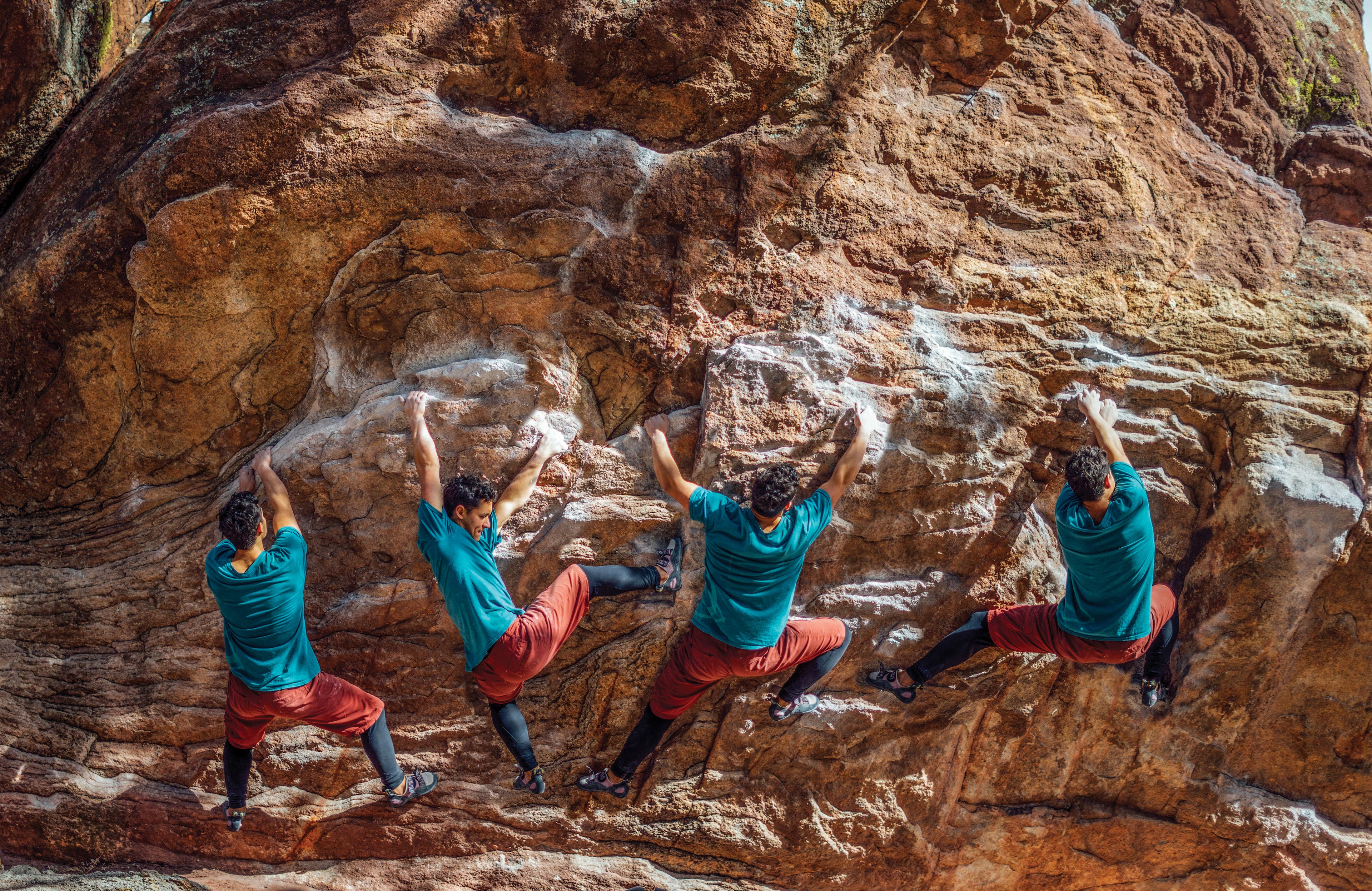
One- to two-movers; contrivances
What it trains: power, max strength
How it works: Create short, difficult problems to pinpoint weaknesses and improve max-effort moves.
The workout: Find a boulder with a high density of holds and features. With two to six people, make up one- to two-move limit problems. They can be drop-offs and even contrived—the point is difficulty, not aesthetics. To work finger strength, make smaller, tick-tacky moves. To work extension and dynamic power, dyno between holds.
Duration: No more than 1.5 hours. If climbing at your max, this should be the point when your ability drops off anyway. If you can’t repeat moves you completed earlier, you’re done.
ADVERTISEMENT
Circuits
What it Trains: Power-endurance, movement efficiency
How it works: By attempting to repeat hard-won additions to your ticklist, you create a circuit of former projects to link in a session. This will teach you to climb well near your limit, develop power-endurance, and boost overall stamina.

The workout: Pick a circuit of four to eight previously vanquished projects difficult enough that you’re not able to easily repeat them—at least not first go. Warm up and then try each problem; only rest while packing up and moving between problems. Approach each problem intelligently, evolving and fine-tuning your beta.
Duration: Give yourself a constraint—either on time (15–20 minutes per problem, max) or burns (no more than five).
ADVERTISEMENT
4x4s
Trains: power-endurance, movement efficiency
How it works: Climb a problem multiple times to improve power-endurance, efficiency, and pump management.
The workout: Climb a boulder a grade or two below your limit four times in a row without resting any longer than it takes to descend and pull back on. That’s one set. After 5 minutes rest, do another set, with a goal of four sets. Note: Pick climbs with good landings and comfy holds. If you whiff off a cliff edge or sever your tip on quarter-pad razors, that’s on you.
Duration: 30–40 minutes
ADVERTISEMENT
Branched traverses
Trains: Endurance
How it works: Traverse a wall multiple times into different exits for endurance mileage.
The workout: Find a long, featured wall with a low traverse (see photo, facing page) and opportunities to top out partway through. Think of the main traverse as a tree trunk and the different exits as branches. You traverse to the first “branch,” where you top out. Descend and hop right back on, traversing out to the second “branch” and so on until you’ve ticked all exits. Have fun de-pumping for the next few days.
Duration: 15–45 minutes
ADVERTISEMENT
“Hangboarding” one-arms
Trains: Lockoff strength
How it works: Strengthen lockoff power through eccentric movement (working a muscle group in reverse), with the goal of a one-armed pull-up.
The workout: Find the perfect natural “hangboard,” say on the back of a boulder or by scouting out lowballs and choss. Select two jugs and pull up, locking off just below shoulder height; let go with one hand and lower slowly with the other arm, completing your negative. Each negative should be done slowly and in control—lasting at least 3 seconds. Complete two to three reps per side and three to four sets total, with 3–5 minutes rest between sets. When this becomes easy, try one-armed pull-ups using one finger on the other hand for assistance. Eventually, you should be able to do a full one-arm.
Duration: 15–20 minutes
ADVERTISEMENT
Hangboarding pulses
Trains: Max grip strength
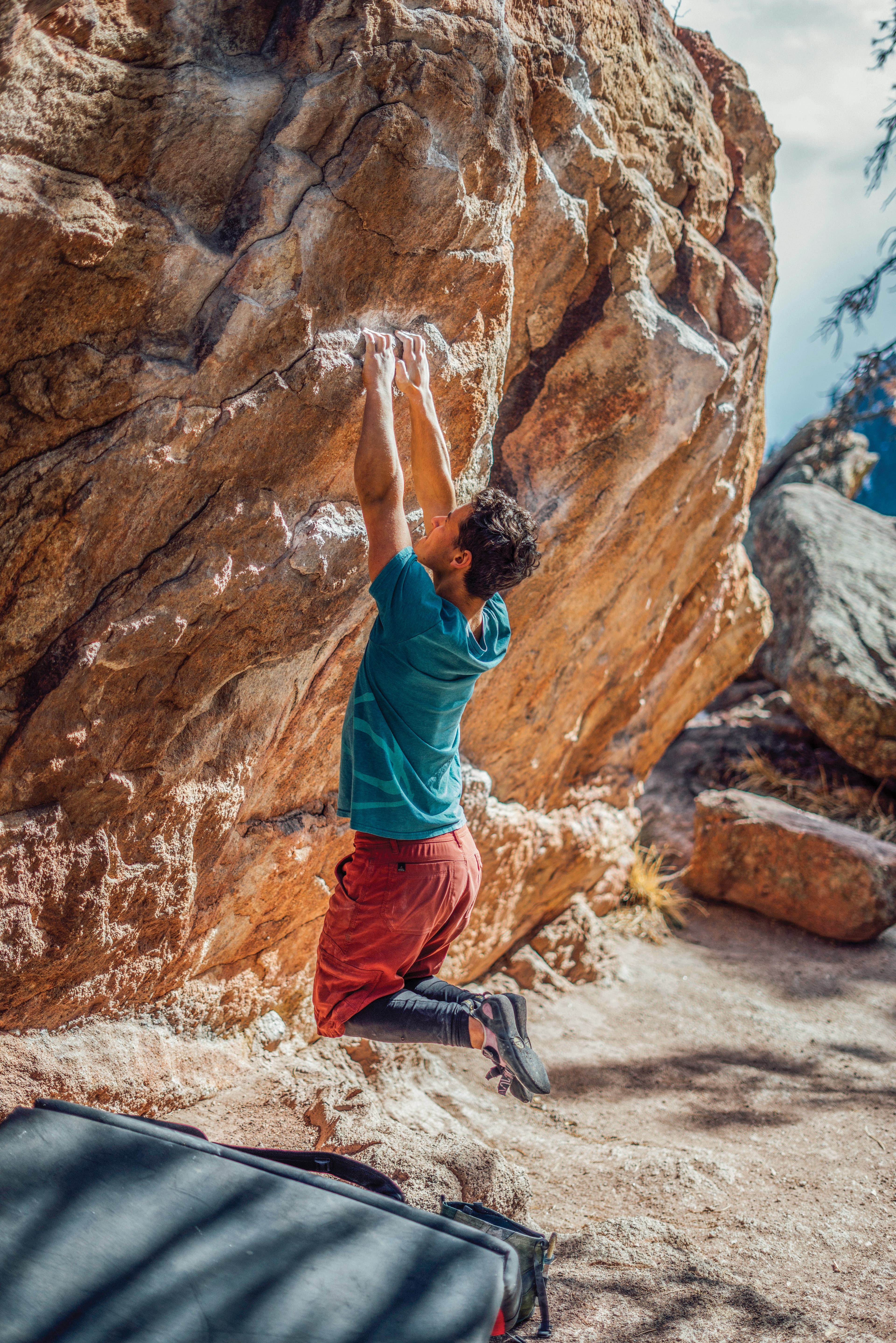
How it works: Increase your max grip strength by hanging on the smallest edges possible.
The workout:
- Round 1: Hang on large edges for 1–3 seconds, completing three hangs total, “resting” only the half-second it takes to step off between hangs. Then drop and open and close your hands rapidly for 15 seconds to increase blood flow. Complete another set of pulses. Continue alternating between pulses and finger flexes for 3-4 sets, then go for a single 8-second hang. Rest for 3–5 minutes.
- Round 2: Find a slightly smaller edge and repeat the above routine, then continue the pulses and hangs, with 3–5 minutes of rest between sets, on continuously smaller edges until you reach an edge close to your max, meaning you reach failure about 7 seconds into your 8-second hang. Rest for 3–5 minutes.
- Round 3: Complete no more than five 7-second hangs on the smallest edges you were able to hold, resting at least 5 minutes between each hang. Don’t overdo it: This is max-strength training, meaning many of the adaptations taking place are neurological. You may not feel “worked,” but the benefits are accruing nonetheless.
Duration: 30 minutes
ADVERTISEMENT
Hangboarding Extra Credit
- Pick a hold on a project and practice offset hangs, gradually giving yourself less assistance with the low hand.
- Hang half- to quarter-pad crimps with toes smearing if needed—gradually rely on your toes less as you improve. Follow the same guidelines outlined in the Hangboarding Pulses workout—that is, no more than five 7-second hangs on the smallest edges you are able to hold, resting at least 5 minutes between each hang.
- With Pulses, if you can deadhang holds smaller than a half-pad for more than 8 seconds, rather than progressing to tinier edges, stay on the same holds, or find slightly larger “comfy” edges, and gradually add weight. A filled water bottle squeezed between your knees is good. As you get stronger, you can become increasingly creative about adding weight. Try wearing a backpack filled with water bottles or rocks, hang from just one arm at a time, or train immediately following an indulgent holiday meal. Enlist a younger climber to sit on your shoulders while you train. Just don’t hurt yourself. And don’t break holds.
Core workouts on tree limbs
Any core workout you can do on a pull-up bar, you can also do on a (stable!) tree limb. Try front levers, leg lifts, windshield wipers, L-sit lock-offs, and anything else. There’s a great tree limb for this on the warm-up boulder near Yosemite’s Dominator. If there’s anyone else in Camp 4 that day to see what you’re doing, accept ridicule gracefully by taking your shirt off and offering to compare six packs.
Caleb Sanderson is from Minnesota and currently lives in Boulder, Colorado. He started climbing at age 12, and participated in the competitive youth climbing circuit for several years before dropping out to climb outside more.