Updated March 13, 2026 12:21PM
How Much Does it Cost to Climb Everest in 2026? We Crunched the Numbers.
A longtime Everest chronicler crunches the numbers
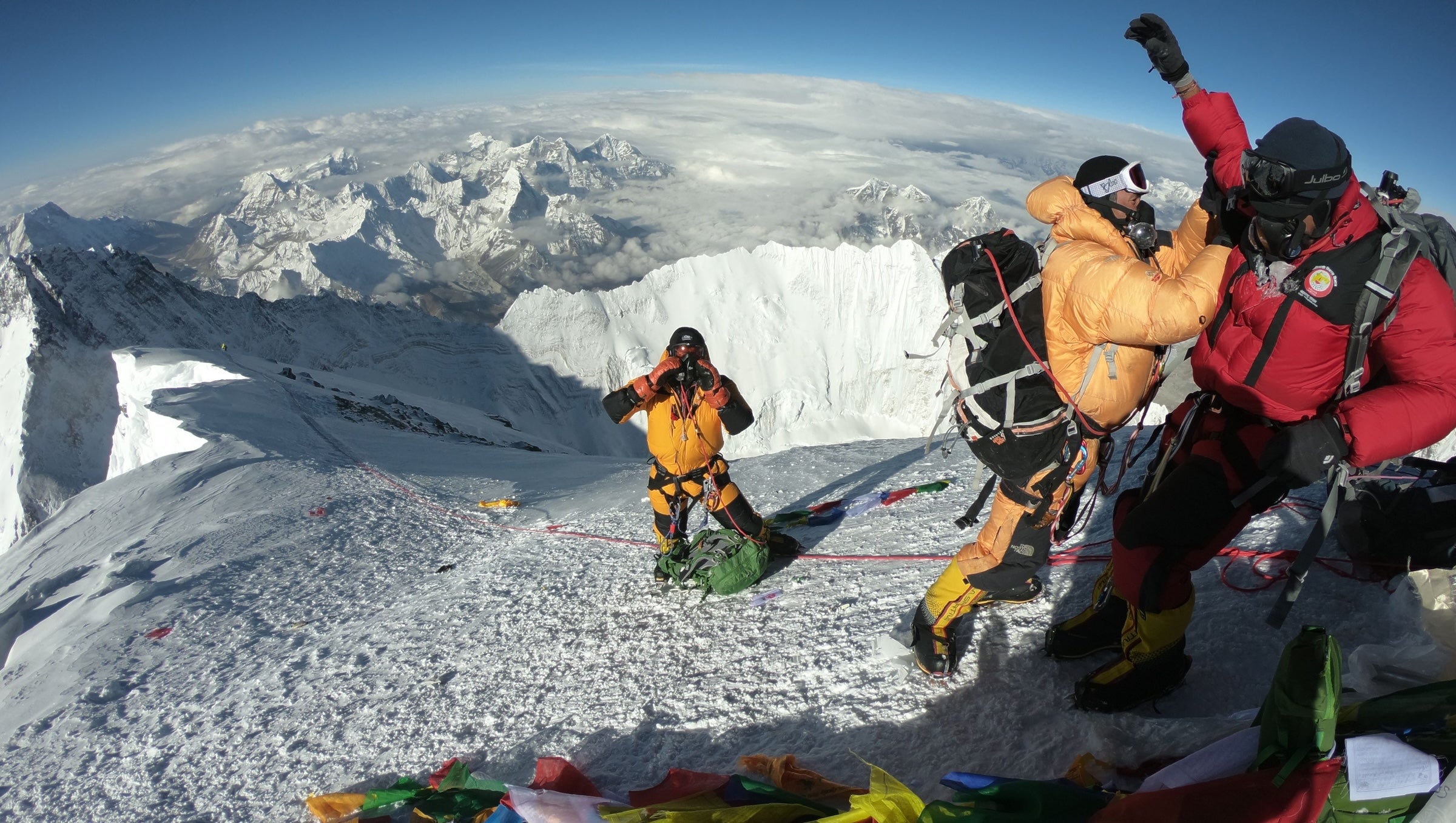
(Photo: Phunjo Lama / Getty)
More or less, every year, the tab for climbing Everest rises. Yet even as it becomes more and more costly to stand atop the world’s highest peak, more and more climbers shell out the requisite cash.
I know a thing or two about both Everest and money. I summited Everest on May 21, 2011, after previous attempts in 2002, 2003, and 2008. And I’ve written many editions of this story (“How much does it cost to climb Mount Everest?”) over the last 15 or so years.
I often field two popular questions about Everest:
1. How much money do I need to climb Everest? I’ve said for years that the short answer is a car, but prices have skyrocketed, so now it’s a luxury car. Most people pay between $45,000 and $76,000. Some will pay as much as $220,000, or as much as $1,000,000. Prices continue to rise. If you are on a tight climbing budget, go as soon as your skills, experience, and checkbook can support a safe attempt.
2. What are my chances of reaching the summit (aka, what’s the ROI on this major investment?) Actually, your chances are pretty good, assuming you have the appropriate experience and go with a qualified team. Since 2011, 61% of people who climbed above Everest Basecamp made the top, according to the Himalayan Database. In recent years, long-time Western operators like Jagged Globe, Adventure Consultants, Furtenbach Adventures, Madison Mountaineering, and others regularly put almost every member on the summit. However, those who believe a talented guide can escort them to the summit are often the ones whose obituaries we read soon after.
So, how much does it really cost to climb Everest in 2026? Large variations in cost and expedition structure exist, so I go into detail below.
Everest 2026 climbing costs: Higher prices, more summits
As in past recent years, prices continue the upward trend in 2026, though increases aren’t dramatic. Many of the rising rates to climb Everest on the Nepal side in the past few years results from higher labor costs, which is a good thing. Sherpas are receiving better pay and insurance policies by becoming certified through the International Federation of Mountain Guides Associations (IFMGA) certification. Nepal has also created new regulations around minimum salaries and insurance. While median prices for Western and Nepali operators on the Nepal side remained relatively flat from 2025 to 2026, Nepal did increase its permit price by $5,000 this season.
On the Tibet side, we’re seeing a sizable increase of 22% in rates for international operators. Increases can largely be attributed to inflation, higher wages, and rising demand.
ADVERTISEMENT
Several companies now offer outlandish luxuries for the aspiring Everest climber. These luxuries mean that the upper end of the price spectrum for an Everest climb can reach as high as $300,000 and even up to $1 million. Some of these outfitters cater to the super wealthy who have more money than time and seek the summit as quickly as possible to return to work. Last season, for example, we saw the debut of the “one week Everest climb,” powered by xenon gas.
So, do you have to be a one-percenter to climb Everest in 2026?
With Nepal’s strong tourism business and high demand, Nepali companies are still open for price negotiations, but not to the extent that they have been in prior years. You can get on a low-end, essential services-only trip for little more than $30,000. As for dealing with foreign operators, don’t count on a significant discount. It’s customary to offer a small price reduction if you pay a year in advance, but that’s about it. They fill their teams months in advance, so there’s little incentive to discount.
ADVERTISEMENT
The following chart breaks down the current median prices (midpoint for prices with half above and half below this price) by style and route. I go into more detail later in this post, but you can see how much prices have increased on both sides for all styles. Foreign operators have higher costs than local operators, which accounts for the significant difference in the prices, but I’ll go into that later.
Median Everest costs in 2026
| Nepal Side 2026 | % Change Over 2025 | Tibet Side 2026 | % Change Over 2025 | |
| Nepalese Outfitter | $45,250 | .06% increase | $47,000 | flat |
| International Outfitter With Sherpa Guide | $54,000 | flat | n/a | n/a |
| International Outfitter With International Guide | $76,000 | flat | $90,800 | 22% increase |
The Everest bill: Breaking down the costs
There are several major cost components to any Everest expedition, regardless of whether you are climbing from Nepal or Tibet:
- Travel
- Permits and fees
- Insurance
- Supplies and gear
- Guides
Below, I break down expenses as if an individual wanted to climb without joining a team, but almost no one does this. As the numbers will show, it is generally just too expensive or risky to climb alone.
I know a few individuals who have climbed on an extreme budget in years past, but few in the last five years. I usually get a reply to this article saying, “Alan, you’re crazy. I climbed Everest and only spent $5,000.” Congratulations if that’s true, but chances are you did it before the turn of the millennium, your ascent was illegal (no permit), or you climbed on the North side before China raised their prices and enforced team size minimums. If someone can tell me how to climb Everest for under $10,000 in 2026, contact me with the details.
ADVERTISEMENT
Note that we provide wide ranges for costs within each of these categories. Rates vary dramatically depending on where you live, what type of guide you’re seeking, how much gear you already have, and many more factors.
1. Travel: $500-$10,125
Travel costs depend entirely on where you live and how you like to travel. While theoretically you could spend as little as $500 if you call Kathmandu home and travel self-supported, most will pay thousands of dollars to reach Everest Basecamp. Flights to Nepal from the United States can cost a few hundred dollars if you’re an expert deal-finder to over $7,000 in business class. The recent spikes in fuel prices resulting from the Iran War may raise the cost of flights to Nepal even more dramatically. Many people use Thai, Turkish, Qatar, Air India, or China Eastern to reach Nepal.
ADVERTISEMENT
Once in Kathmandu, you will fly to Lukla, Namche, or Lhasa to start the journey to basecamp, so add a few hundred dollars for this airfare. You could also take a bus to Jiri, trek five days to Luka, then continue on to Everest Basecamp to save a little money.
From Lukla, it takes a little over a week to trek to Everest Basecamp and acclimate, so add food and lodging for you and your support team. The trek costs can range between $400 to $1,000 per person. But, depending on your travel style and how many beers you buy, you can save money. Remember that everything becomes more expensive the closer you get to Everest Basecamp, so buy batteries, toilet paper, etc., in Kathmandu, Lukla, Namche, or, better, at home.
Teahouses have dramatically increased their prices in Khumbu. You can find $9 per night teahouses, but expect to pay $10-$15 for each meal. Climbers can always camp in tents and cook their meals to save money, but if you camp and eat in the teahouse, expect to pay four times the price if you don’t sleep in the teahouse; they make their profit from selling meals.
ADVERTISEMENT
You must get yourself and all your gear—tents, food, oxygen, etc.—to basecamp. Most people use porters and yaks, which cost at least $25 per day per load but are usually higher, often totaling over $1,000. Large operators will hire helicopters and bundle the expense with the overall price. On the Tibet side, your climbing permit includes all transportation, i.e., a 4WD vehicle driven by an employee of the China Tibet Mountaineering Association (CTMA). In addition, the CTMA will meet you where you arrive in China and remain with you during the entire expedition, except when you climb above basecamp.
A breakdown of travel costs:
- Airfare: $1,500-$7,000, depending on class, routing, and excess baggage
- Transportation from Kathmandu to Lukla: $500 roundtrip per person
- Hotel and food in Kathmandu: $400-$800, depending on delays and quality
- Nepal Visa: $125 (90 days)
- Immunizations: $200
Getting to Everest Basecamp: $1,240-$1,800
- Yaks to and from Everest Basecamp: $40 per yak per day carrying 120 lbs (four yaks for four days minimum, or $640)
- Extra yak in China: $300/yak
- Porters to and from Everest Basecamp: $25 per porter per day carrying 60 lbs (three porters for six days minimum, or $450)
- Tea houses and food on the trek to Everest Basecamp: $30-$125/person/day (seven days: $210-$875)
- Park fee: $100/team
2. Permits and requisite fees: $9,950-$27,500
Nepal permits
The permit simply allows a climber to climb. Whether you’re climbing in Argentina, Alaska, or Nepal, climbing permit fees help fund high-altitude ranger camps, seasonal staff, mountaineering information, and a clean mountain environment. When you climb Denali, for example, the permit includes helicopter evacuation for life or limb emergencies, but not for low-level sickness.
Last September, Nepal rose its Everest permit rates for most routes from $11,000 to $15,000 for the spring season. Nepal also requires a local company to organize your permit, which costs $3,500 per team, including a refundable trash deposit of $4,000 per permit, and a Liaison Officer at $5,000 per team. These costs total $12,500 before the $15,000 per person climbing permit. So, before you pay for guides, yaks, food, or gear, you must come up with over $25,000 to start your climb from Nepal.
Nepal also requires every foreign climber to hire a local Sherpa Guide. This rule remains in place for the 2026 season, but this policy is unevenly enforced, if at all. While it is very unclear how or if this rule is enforced for every operator, it adds a minimum of $5,000 to the absolute lowest cost. In 2017, one person who climbed without a permit was caught, deported, and banned from climbing in Nepal for five years by the Nepali authorities. Both sides are cracking down on unauthorized climbing, so beware.
ADVERTISEMENT
Tibet permits
An Everest climbing permit from China (the North side) costs between $15,800 and $18,000 per person for a team permit of four or more. This price includes transportation from the entry point in China (usually Lhasa or Zhangmu–Kodari) to basecamp, hotels, a liaison officer, a trash fee, five yaks in, and four yaks out per member. In addition, you’ll pay an extra charge of $200 per day per person for time spent in Lhasa. If you want to bring a Nepali Sherpa to climb with you in Tibet, budget an additional $4,500 for each Sherpa’s “work permit,” as required by the CTMA, plus a salary of $5,000.
3. Climbing team fees: $30,400 (for Nepal side)
- The Nepal Agency fee: $3,500 per team (usually included in the total price from a guide)
- Nepalese Liaison Officer: $5,000/team (usually included in the total price from a guide)
- South basecamp medical support from Everest ER: $100/person
- Nepal permits: $15,000 for each climber, regardless of team size
- Chinese permits: $15,800-$18,000 per person for teams of four or more, plus $4,500 for each Nepali Sherpa
- Nepal garbage and human waste deposit: $4,000/team permit (refundable, but not always)
- Tibet garbage and human waste deposit: $4,000/team permit (refundable, but not always)
- Icefall doctors to fix route: $2,500/team or $600 per climber
- Contribution to fixed ropes above icefall: $200/climber, higher on the Tibet side
- Weather forecast $0 to $1,000
- Puja ceremony (required): $300
On the Tibet side, expect to pay about $19,800 in climbing team fees.
ADVERTISEMENT
4. Insurance: $65-$36,000
Most guide companies on the Nepal side require at least evacuation insurance and medical coverage. One of the best investments you can make is adding trip cancellation to the policy, though this can be costly. In 2014 and 2015, when the Everest season ended early, those with trip cancellation/interruption coverage received 100% reimbursement for their trip expenses, with some claims reaching as high as $45,000.
ADVERTISEMENT
Several companies cover medical evacuations from the injury site to a local or home medical facility. Some also cover trip cancellations, while others offer medical insurance. These policies have become quite costly, so it’s wise to shop around. Many operators negotiate discounts with these companies if you access their website through your guide’s site or by calling them. Excellent insurance options include Travelex, Global Rescue, Redpoint Ripcord Rescue Travel Protection, AIG Travel Guard, and International Medical Group’s TravelLX.
To save money, join the American Alpine Club, which will provide $7,500 in evacuation coverage to a local hospital and, optionally, up to $300,000 to get you back home. These are bargains at $65/year and $250/year, respectively. Most people upgrade that basic coverage for a few hundred dollars.
To be covered by any policy, you must follow their rules strictly—and I mean to a tee. If you make one misstep, the policy will not cover your expenses. Also, most do not cover searches if you get lost, and those who offer coverage have low limits.
ADVERTISEMENT
The Tibet side is more complicated when it comes to evacuation insurance since a centralized team performs all on-mountain rescues. The rescued climber is responsible for an unspecified and unlimited fee. Helicopter rescues are not allowed, but are rumored to begin in the next few years, maybe by 2026. When climbing in China, it’s wise to double-check everything with your provider and evacuation coverage company to understand the details.
- Evacuation insurance: $65 (American Alpine Club) or ~$500 (Global Rescue/Travelex)
- Medical insurance only: $500
- Rescue insurance for any reason with medical insurance and trip cancellation coverage: $3,000 to $15,000 (Travelex)
- Private pay helicopter evacuation from Everest South: $5,000-$20,000, depending on start and end locations (not available in Tibet)
- All insurance figures are representative and vary widely with age, length of trip, and total cost
5. Supplies and gear: $32,500-$60,550
While the costs of the equipment you’ll need for an Everest ascent aren’t necessarily isolated or exclusive expenses, if you want all-new stuff or are a novice who lacks the gear to begin with, the bill is a bit staggering. As far as the gear goes, many climbers may already own all the climbing gear and layers required, leaving them with the costs of oxygen (presuming they’re using it), food, and more non-negotiables. Others may be able to save by purchasing used gear or borrowing equipment. Some of the costs outlined below are also shared costs across a group or team, e.g., a tent and cook.
On Everest, 98% of all summiteers use supplemental oxygen. You can cook your food, but most employ a cook and helpers, costing $7,000 for basecamp and budgeting about $1,000 per person for food and fuel while climbing Everest over six weeks.
ADVERTISEMENT
Supplemental oxygen costs about $650 per bottle, with a minimum of five bottles totaling $3,250. You will also need a mask, which costs $550, and a regulator, which costs another $550. You can carry your extra oxygen to the high camps, but most people use the Sherpas to cache it there. When hiring a personal Sherpa, the standard is for the Sherpa to climb on oxygen, albeit at a lower flow rate, which will cost an additional $4,000 to $10,000.
Finally, you will need climbing gear, including 8,000-meter boots, a down suit, clothing layers, gloves, sleeping bags, packs, and more. If you buy everything new at the list price, these items cost at least $21,000. You can likely thank tariffs and inflation for the estimated $2,000 additional you’d need to spend in gear this year compared to prior seasons. High-altitude boots from La Sportiva or Millet run $1,200, a full-down suit from Feathered Friends or Mountain Hardwear costs over $2,000, and a sleeping bag rated to -20F costs at least $1,000.
You can often find lightly used climbing gear on eBay or less expensive gear in Kathmandu. I recommend buying boots at home so you can get the correct size. Remember that your feet will swell by at least a full size at high altitudes, so buy your boots and try them on at home with your climbing socks to test the fit before leaving for the climb.
ADVERTISEMENT
Miscellaneous supplies: $17,700-$35,700
- Full medical kit: $1,200-$1,700, plus $3,000 for Gamow Bag (a hyperbaric bag for altitude sickness)
- Sherpas, cook tips, and a bonus of $600: >$4,500 per individual, depending on performance and summit
- Personal gear (down suit, high-altitude boots, sleeping bags, etc.): $21,000
- Satellite phone: $1,000-$3,000, depending on usage
- Gear allowance for Sherpas: $3,500
Everest Basecamp and High Camp expenses: $3,800-$8,800
- Tents: $3,500 new (sleeping, cooking, toilet, and storage at four camps for three people)
- Cooks: $6,000 per cook and assistant for six weeks
- Food and fuel: $1,000 per person for six weeks
Climbing support supplies: $4,350-$18,350
- Oxygen: $650/bottle (five bottles) = $3,250 (doesn’t include costs to take to high camps)
- Oxygen mask (Summit Oxygen): $550
- Oxygen regulator: $550
- Climbing Sherpa: $5,000-$10,000 per personal Sherpa with oxygen at $4,000
ADVERTISEMENT
4. Guides: $30,000-$85,000
As implied above, managing all the costs can be overwhelming. But don’t despair!
You can join a fully supported or guided team that takes care of everything. For decades, western operators like Adventure Consultants, Alpine Ascents (AAI), Jagged Globe, Himalayan Experience (Himex), International Mountain Guides (IMG), and others have guided Everest for prices ranging from $49,000 to $115,000, all-inclusive.
But the dominance of Western guides is changing. There has been intense competition from Nepali-owned and operated companies in the last few years. With many Sherpas that have summited Everest 10 or more times, they advertise themselves as Everest guides and eliminate the traditional Western guide (each of whom typically earns between $15,000 and $25,000 for the season). This cost-saving is passed through to clients. In the last few years, Sherpas have begun earning salaries similar to Westerners, so the price gap has narrowed.
ADVERTISEMENT
Many lead Sherpas now have a subset (no ski qualification, for example) of the IFMGA certification—and have more summits than many Western guides. This certification allows the Sherpas to earn up to $10,000 per season compared to the $4,000-$5,000 they previously made.
As more Sherpas become certified, the cost of the Nepali companies is rising. But some Nepali operators still have a practice of underpaying their staff and then charging clients half as much as traditional Western operators. (For instance, in 2021, Seven Summits Treks reportedly offered their Everest expedition for as low as $28,000 per climber.) Also, bartering is more widely accepted among Nepali guides, who sometimes privately negotiate and provide discounts—something that few foreign operators will do.
2026 Everest expedition price breakdown: The data
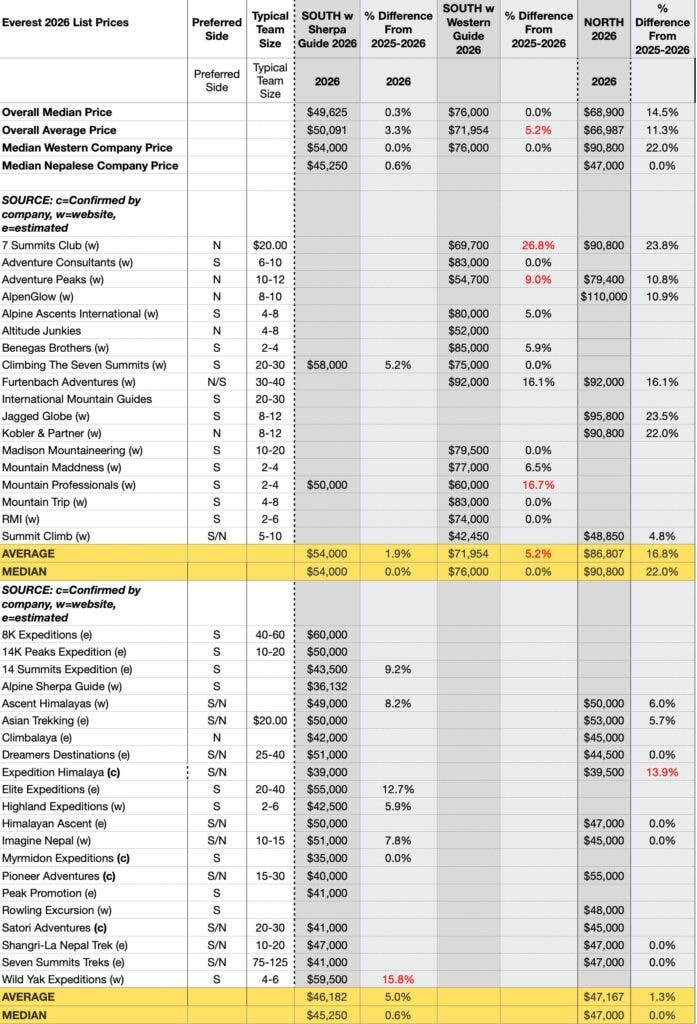
Drawing on this background information and data available on public websites, I have compiled a list of 2026 Everest fees from the major Everest guide companies. Calculating summit successes, I looked back at recent summit rates, their websites, and the Himalayan Database.
This list is not comprehensive; some guides are not included, and I did not look at smaller operators or operators who don’t run climbs every year. I’m not making endorsements by including or excluding a company from the list. It should be used for initial reference only. For confirmation, details, or questions, please consult each operator directly.
(Also: the term “member” here is used to describe paying clients.)
How cost varies by expedition type in Nepal
Three options exist for supported Everest climbs: 1) Sherpa-supported expedition, 2) Sherpa-guided expedition, or 3) an international (often Western) guided commercial expedition.
Almost every foreign guiding company offers multiple options today, ranging from Sherpa-guided and Sherpa-supported expeditions, to Western-guided ascents, to entirely private climbs. Most companies also offer climbs just to Camp Two or the North Col to climbers less interested in making the summit than just being on the mountain.
ADVERTISEMENT
Sherpa-supported expedition
(Please note that the term “Sherpa-supported” does not constitute a guided expedition, which is what most Nepali-owned companies offer.)
While the cost can range from $30,000 to $55,000, you can generally climb on a Sherpa-supported expedition for about $45,000. The cost is about 5% higher than 2024. The company organizes all the logistics: food, group gear, transportation, and Sherpa support, but does not provide Western guides or, in some cases, even a lead Sherpa guide. The Sherpas may or may not speak English very well and will most likely let you make on-mountain decisions about when to push forward or turn back. In other words: You are fully responsible for your safety and life.
ADVERTISEMENT
You must be extremely careful when selecting amongst these companies: Some are excellent, others are lacking. A Sherpa will climb with you on summit night, but you might be on your own, or with random teammates, throughout the rest of the acclimatization climbing process, including preparing meals at the high camps. It is pretty common to find yourself climbing only with a Sherpa or even by yourself. The Sherpas may have attended a climbing school, like the Khumbu Climbing Center, which is excellent, but they will usually lack basic medical training and may not be capable of offering significant help in a health crisis other than getting you lower—a step that, of course, is substantial and often lifesaving.
Expect to pay between $35,000 and $55,000 for this option, which is suitable for climbers with significant high-altitude experience. It is absolutely not for novices or for climbers embarking on their first 8,000-meter peak.
Sherpa-guided expedition
International Mountain Guides (IMG) Classic Everest Climb is a Sherpa-guided expedition in which an experienced Sherpa leads climbers throughout the route. Climbing The Seven Summits charges around $58,000 for this option. Both companies have increased their prices over time. Usually, this model uses highly experienced senior Sherpa—also known as a Sirdar—to make big decisions, such as when to go for the summit or turn around. Meanwhile, these companies often have a Westerner overseer who stays at basecamp.
Another option is to hire a personal Sherpa for an additional $5,000 to $10,000, (plus 5% to 20% for tips and bonuses). These Sherpas have significant experience and training in dealing one-to-one with Western climbers, and their English skills are usually excellent. While they will not carry all your gear, they may offload some of your items on occasion. They will be with you exclusively on your summit night, even if you decide to turn around before the summit. As with the Sherpas on Sherpa-supported expeditions, these personal Sherpas may lack medical training, but you will never climb alone.
ADVERTISEMENT
This style is appropriate for climbers with previous 8,000-meter experience and strong climbing skills, but is not for novices. I used this model with IMG and Kami Sherpa in 2011 for my successful summit bid and was very pleased.
International commercial guides
The Western-guided expeditions are full-service trips and are most appropriate for first-time Everest climbers or anyone looking for maximum levels of support. The cost varies widely, ranging from $65,000 to $125,000. The fee includes all the services of a Sherpa-guided climb plus sharing one or more Western guides. If you want a personal Western guide, expect to pay at least $120,000, plus tips and bonuses, which add up close to $175,000.
The primary point of this approach is that you are climbing close to a Western guide who has probably summited Everest several times. There is no language barrier and the guide will have some wilderness medical training. The guide will make all the decisions about turnaround times, weather, and emergency management.
ADVERTISEMENT
On these higher-end expeditions, you will also have high-quality food, ranging from well-prepared to exotic. (One service likes to promote their sushi, another their five-star chef.) Then there are espresso machines and open bars. The sky is the limit, but it all comes at a cost. The most expensive guide companies (Adventure Consultants, AAI, Alpenglow, Furtenbach, CTSS, Madison, etc.) always come with several Western guides, and you never climb alone.
Luxury Everest guides
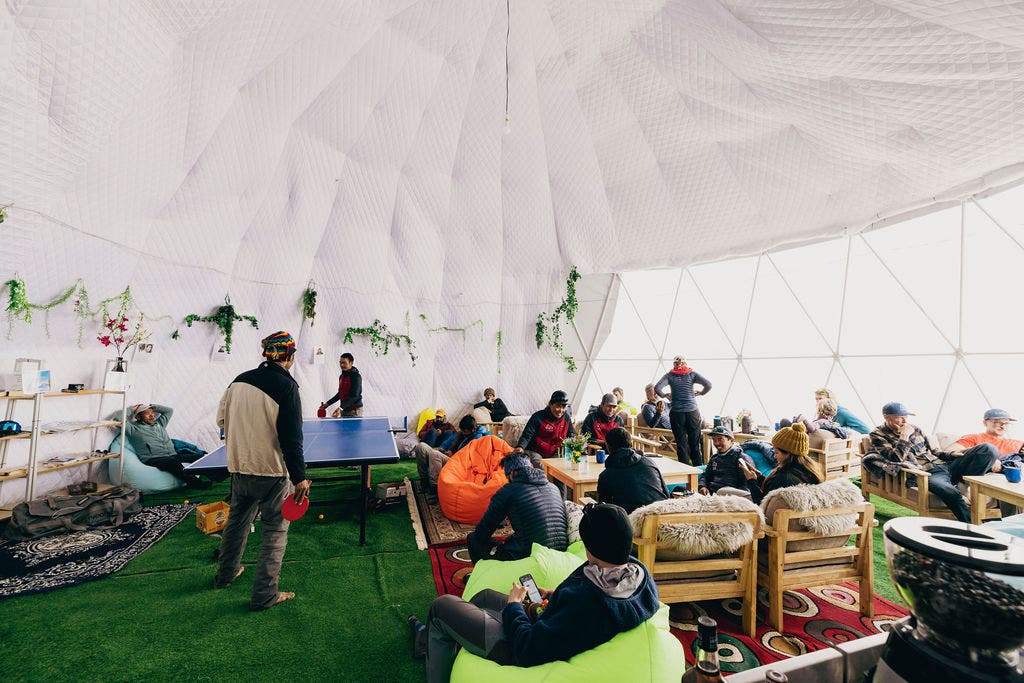
Seven Summits Treks: Catering to the China market, Seven Summits Treks has raised the luxury level with their VIP Everest Expedition. A few years ago the cost was around $130,000, but likely clocks in closer to $300,000 now. The expedition includes extravagances such as:
- Private camp facilities with luxurious dining areas and a private cook
- A medical dome tent
- WiFi-enabled workspaces for the most extreme digital nomads among us
- A tent with a King-size bed, kitchen, hot shower, and toilet at basecamp
- Helicopter-supplied fresh fruits, vegetables, meat, mineral water, and other food items delivered almost daily
- A two-hour helicopter flight around Mount Everest for filming and panoramic views
- 12 bottles of supplementary oxygen per member
- A rescue team of Sherpas standing by at Camp II for emergency and rescue purposes
- A relaxation tent offering yoga, meditation, and massages
- And a documentary movie of your entire trip.
Furtenbach Adventures Signature Everest Expedition: Another top-end option is from Austrian-based Furtenbach Adventures. In addition to their typical high-service standard trip, clients of the Signature Expedition (who pay around $230,000) get full support from the expedition’s preparation phase to the summit, including, among other amenities:
- “Private mentoring from Lukas Furtenbach”
- A “personalized training plan put together by a professional sports physiologist”
- A custom nutrition plan
- Support from two personal climbing Sherpas
- An unlimited supply of oxygen
- An 80 square meter heated tent with a private bathroom in basecamp
Furtenbach also offered a xenon gas-powered climb last spring that cost $150,000.
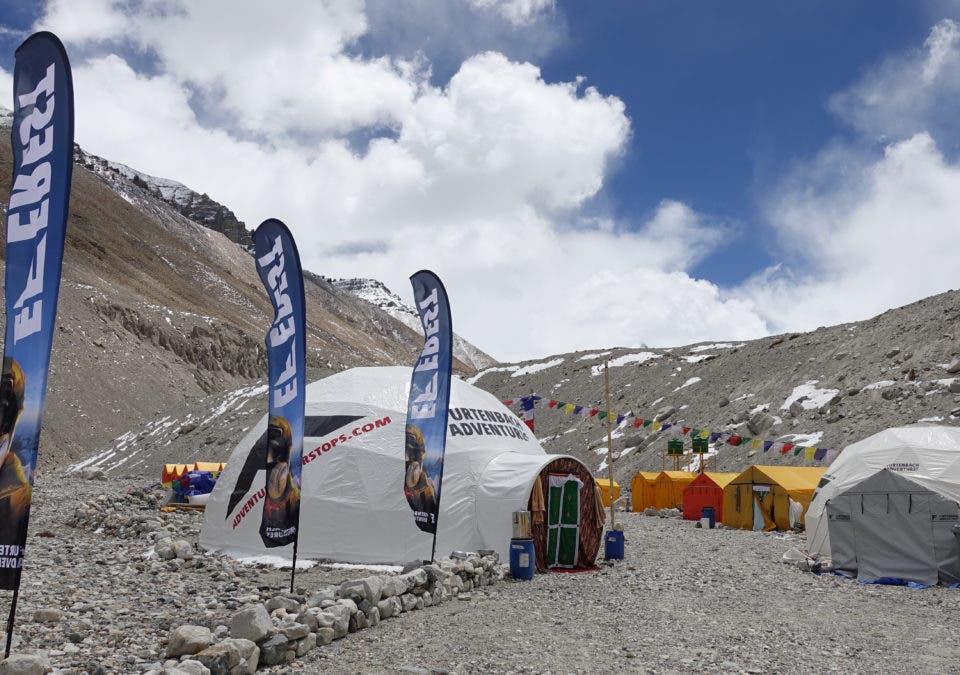
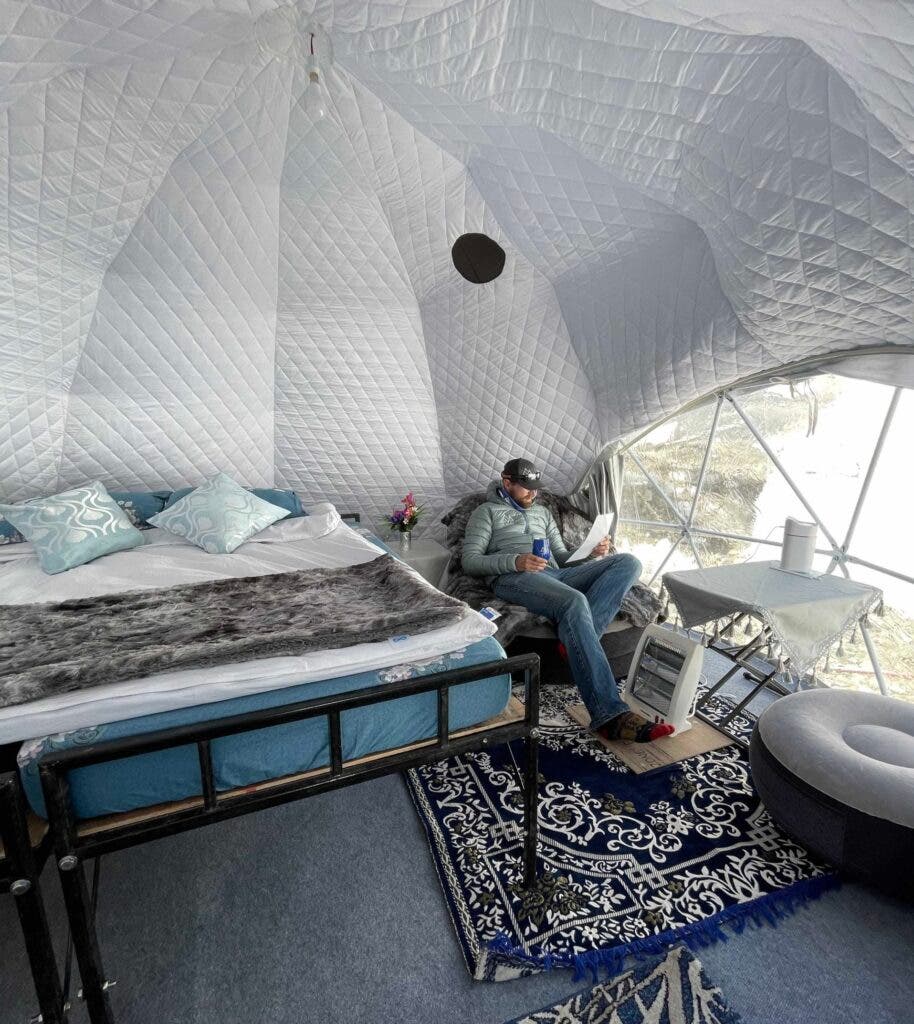
Climbing the Seven Summits’ Everest Executive Domes Upgrade: As part of its suite of climbing services, Climbing the Seven Summits gives its clients the option to upgrade to hotel-like domes kitted out with heaters, queen-sized beds, “windows with curtains to take in the epic views,” private WiFi-enabled workspaces, “morning beverage service” for an additional $14,995.
ADVERTISEMENT
The cost of rapid climbs
A relatively new option offered by many foreign guides and a few Nepali ones is a fast climb, which takes one to four weeks. The primary market is people who can spend well over $100,000 but cannot be away from work for more than a month. Alpenglow and Furtenbach have been the most aggressive with this model, but others offer it.
ADVERTISEMENT
The idea is that by minimizing your time on the mountain, you conserve energy and risk to illness. Using an altitude tent 30 days before leaving home, you arrive at basecamp acclimatized to 17,000-feet. Thus you eliminate one or more acclimatization rotations, increasing your chances of summiting.
The package usually includes pre-acclimatizing in an altitude tent, an AMGA/IFMGA guide, virtually unlimited oxygen flowing up to 8 lpm in some cases, and plenty of Sherpa support. Unfortunately, all of this extra support drives the price up.
Frequently asked questions on the cost to climb Everest
Can I save money by just climbing Everest alone?
Officially, no. Nepal’s Ministry of Tourism requires every climber to hire a Sherpa guide. The China Tibet Mountaineering Association has a similar requirement. But like everything around Everest, there are exceptions, and most rules are never enforced.
What is the minimum amount of money I can spend to climb Everest?
As previously addressed, it is almost impossible to climb Everest entirely alone on the standard route. However, you can climb independently with no oxygen, Sherpa, or cook support, using ladders and ropes on the south side. For one person, this would cost at least $25,000. Even splitting group expenses, the base costs add up to $30,000 per person for a seven-person team. When you add in oxygen and basecamp support, a one-person climb with Sherpa support approaches $49,000, but a seven-person team leveraging the group costs comes in at $39,000.
ADVERTISEMENT
What is the difference between a $45,000 and a $75,000 Everest climb?
There is a real difference in offerings by some companies and very little with others, so it’s up to the climber to shop wisely.
ADVERTISEMENT
The general rule is that the lower the price, the larger the team. At the high end, profit, overhead, and the number of Western guides drive up the price. The less expensive outfits promote a low price, but charge for other not-so-optional “options,” such as oxygen, Sherpa support, and food above basecamp.
Another common practice is to pay support staff the absolute minimum, whereas the guide companies pay a livable wage for their entire team.
One well-known, low-cost operator had all their tents destroyed one year and had no backup tents, so they had to beg other operators for spares. They also ran out of food.
An example of price confusion is Sherpa’s bonuses. A low-cost service may not include a bonus, whereas another may. For instance, one Nepali company asks the climber to pay $1,500 to their Sherpa if they reach the South Col and another $500 if they leave for the summit. The tips are in addition to the base price. But a different company includes these bonuses in their overall package. It is customary to tip your guides (both Sherpa and Western).
ADVERTISEMENT
Alan Arnette is the oldest American to summit K2 in 2014 and has six expeditions on Everest or Lhotse with a summit of Everest in 2011. He climbs to raise money and awareness of Alzheimer’s disease. This data and more deep dives for 2026 can be found on his website.


