Updated February 11, 2026 11:35AM
A Climber Gets Called for A Search and Rescue Mission. The Real Danger Wasn't the Terrain.
Acclaimed author Jeff Jackson gets called to help find Amanda Eller, who was missing for weeks. What he finds reveals true nature in all its forms.
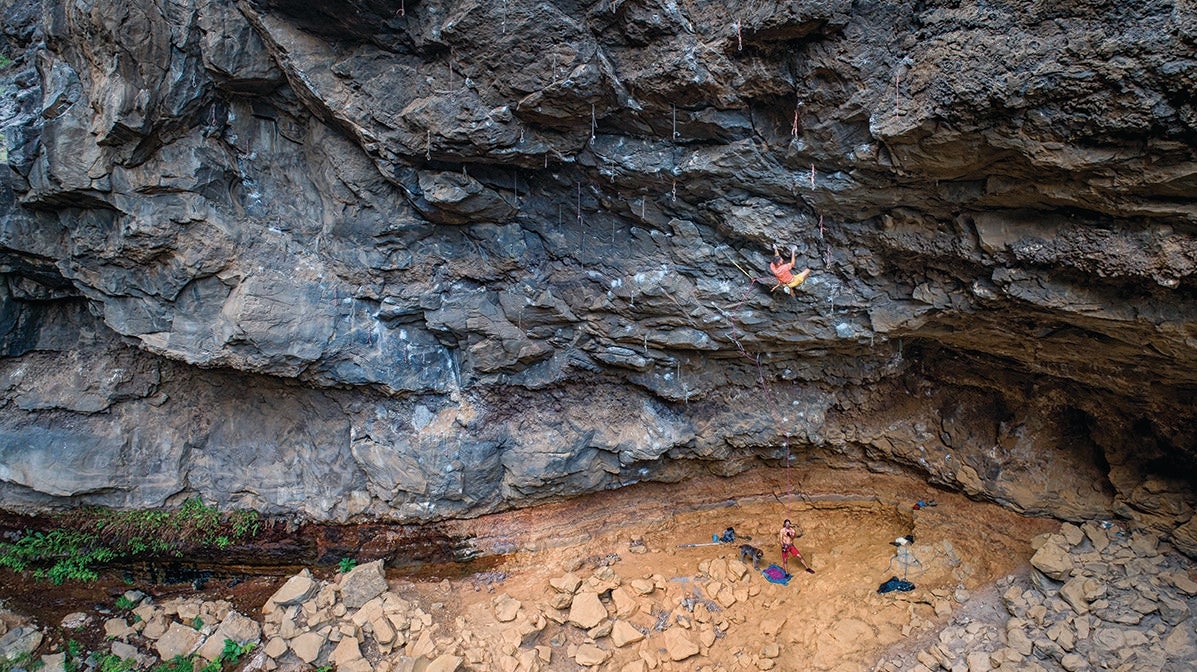
“Uncle” Chris Janiszewski takes the Kahikinui Sleigh Ride (5.14b) at Manawainui, Maui, Hawaii. He redpointed the line—the hardest in the state—four days after this photo was taken. (Photo: Drew Sulock)
It’s eight in the morning, May 22, 2019, Maui, Hawaii.
I was sitting with my boys, Kai, age 11, and Isaac, 7, at the intersection of Haleakala and Kula highways when my phone rang. A blustery Southern-accented voice spoke.
“Aloha, Jeff. This is Javier Cantellops, I got your number from Chris Berquist. He said you were a climber?”
I’d been climbing for 42 years.
“Yes,” I said. “I climb.”
“Well, you know about the Amanda Eller disappearance, right? The girl who disappeared in the Makawao forest?”
Everybody on the island was talking about Amanda. She’d gone missing in the Kahakapao Reserve, a massive forest of redwood and eucalyptus up Pi’iholo Road. Left her keys on her car tire and went for a run. She’d been lost for a couple of weeks.
“Yeah, I heard about it,” I said.
ADVERTISEMENT
“I’m heading up the search,” Javier said. “I need to get down some waterfalls. They call one of the falls Big John. Two hundred feet or better. I don’t feel confident rigging the rappels, but I need to free-dive those pools, see if I can find … something. Could you help me out, brah?”
A woman was lost in the forest. Vox clamantis in deserto. A distant cry for help.
“I’ll meet you in the horse lot at upper Kahakapao tomorrow morning at eight,” I said.
Something snapped. I grabbed him by the shirt and swung hard. The punch whiffed as he jerked back and broke free.
Jacarandas hung over the road, dropping purple flowers onto the hood of my truck. The blossoms swirled in the slipstream of rental cars—Jeeps and convertible Mustangs. Seventy-five degrees, trade winds blowing at 15 m.p.h., windows down. Three thousand feet below, the Great Pacific Ocean blasted sunshine. An amazing day. A perfect day.
Isaac was chucking spicy rice crackers into his mouth. “I love these,” he said.
“I don’t,” Kai said. “I don’t like hot things.”
I tousled his hair. “You’re my fair-skinned blond boy who doesn’t like hot sun or hot food.”
ADVERTISEMENT
“Papa!” he said, incredulous. “I’m not fair-skinned!”
“Sure you are,” I said. “You’re a haole, just like me.”
Haole, pronounced “how-lee,” is Hawaiian for white person. I reached over and lifted the leg of his board shorts and pointed to the white skin. I pulled up my shorts and pointed to my own pale skin. “See?”
“That’s funny,” he said. “I thought I was brown.”
“No, you’re white under the tan,” I said.
I turned 11 in Texas in 1975 and I’d damn sure known I was white. Kai had no concept of his race! How could that be? I smiled and felt heartened. It was a rare intimation of social progress in an era that felt like a backslide toward ignorance and bigotry. Maybe things were changing, after all?
I turned left, drove slowly up the Kula highway behind some gawking tourists, and dropped the boys at school.
ADVERTISEMENT
May 23, 8 a.m.
Turned out that the upper lot at Kahakapao served as the epicenter for the search effort for Amanda, crowded with EZ Up tarps and tents. People in hiking gear mulled around drinking coffee, looking through poster-sized topos with hashmarks drawn over areas that had been searched. Horse riders clomped around in the rainforest mud. Dogs—mostly pit bulls used for pig hunting—pulled on leashes and were scolded.
I saw Uncle Lance Endo standing near his 4-Runner, smiling with that one tooth that floats forward and left of his incisor like an outrigger.
ADVERTISEMENT
“Howzit?” I asked.
“O.K.,” he said.
We shook hands and banged shoulders.
“Who’s in charge of this pa’ina?” I asked.
Lance, who is Filipino, Japanesem and Hawaiian, laughed a gravelly, ex-smoker laugh. He grew up on a ranch in Ulupalakua. Did two tours as an Army helicopter mechanic, one in Afghanistan, one in Iraq. He saw terrible things. Saw hundreds of starving people crushed under a load of humanitarian aid dumped from his chopper. The images sent him back to the island changed. Now he’s on full disability. Like a gruff, profane angel, he drives around looking for people to help. Flat tire? Uncle Lance will help you out. A trip to the green-waste dump? Uncle Lance will help you load and unload your truck. Need a ride to the airport? Call Uncle Lance.
“This is Maui. Nobody in charge,” Lance said.
A Latino guy walked up, waving. “Jeff Jackson?” he asked.
ADVERTISEMENT
I recognized the accent. Deep South.
“Javier Cantellops,” he said, and held out his hand.
“You know how to rappel?” I asked.
“A shark Just appears out of nowhere. Bam. Your leg is gone. Then it doesn’t even eat it.”
“Listen, Jeff, I’m ex-military. Army Ranger, five years, two tours of active combat. You can imagine what my drill sergeants did with my last name. I can rappel out of planes and helicopters, down cliffsides and ravines. I can climb, too, rock and ice and vines and shit. Hell, I could even climb that coconut palm there, if the barks didn’t slip.”
“You got your own gear?” I asked.
He set his bulging backpack in front of me. It was the size of a mining-truck tire.
ADVERTISEMENT
“Son, I got gear for days. I got more gear than the Baptist Foundation. I got carabiners and figure eights. I got ass-cenders and dee-scenders. I got ropes, slings and harnesses. I got food and water and electrolytes. I got … ”
His phone went off. The ring tone was the George Jones standard Chugalug.
“Chugalug, chugalug,
Make you want to holler hi di-ho,
burns your tummy don’t you know … ”
He answered the phone. “That’s affirmative. I’m with the climber now. We’re heading to Big John. Over.” To me he said, “Shake a leg, amigo. This ain’t no nature walk.”
As we walked, Javier told me his life story, straight through. Born in Puerto Rico, but grew up in South Carolina. Enlisted out of high school, volunteered for special ops, killed lots of people. After his military junkets, South Carolina seemed parochial and the climate hellish. Two years ago, he moved to Maui, set up a dive school, and started running snorkeling tours.
Javier’s story seemed rehearsed and motivational—like a TED talk. Self-promoting, entrepreneurial. Eventually the mana of the forest took hold and Javier stopped talking.
Infinite black space tents the night sky. Below, volcanic rock plunges 19,680 feet through sapphire depths. You can sense it just behind the ambient noises—the quiet—like a wet wool blanket thrown over a tiny boat lost at sea.
ADVERTISEMENT
Kahakapao is one of those silent forest/cathedrals found only in Hawaii. Pine trees rise up like green-skirted towers and drop foot-long needles that turn red, yellow and gold. Six-foot-thick eucalyptus trunks lie across the path, snapped off in hurricane winds or top-heavy and uprooted, the mass of radicles ripped out of the ground and standing upright like a skein hung with mud and rock. Quarter-moon Koa leaves yellow the black mud. Pink guavas, half-eaten, mar the pig wallows. Lilikoi—yellow and purple, heavy with tangy paste—hang in the ferns and Ti plants. These things—the aina—are beautiful beyond compare, but the scenic beauty alone doesn’t account for the mana. In some places, a power hangs beyond the waterfalls. It causes people to stop and grow quiet, even Javier Cantellops.
He held his finger to his lips. His eyes darted around as we listened to the silence. Maui is one of the most geographically isolated places on earth. The closest population center (besides the neighboring island Oahu’s Honolulu) is L.A., roughly 2,600 miles east. North, south, east, and west—open ocean.
Infinite black space tents the night sky. Below, volcanic rock plunges 19,680 feet through sapphire depths. You can sense it just behind the ambient noises—the quiet—like a wet wool blanket thrown over a tiny boat lost at sea.
We turned downhill at the water-department cistern and entered a copse of redwood. I took note of a tree thickly carpeted with virid moss. It was raining. Drops of sweat and water washed into my eyes.
“This is where the dogs lost her scent,” Javier said, pointing to a stream—the Waiohiwi—that bisected the deer track. “We gotta rappel the falls. It’s possible she was—something might have happened here, and she could have been washed down. Uncle Kekai said Big John is a 200-footer. I got my mask and snorkel.”
ADVERTISEMENT
“How many days has it been?” I asked.
“Sixteen,” Javier said, tightening his jaw.
We’re looking for remains, I thought.
The gulch cut a runnel through the blue rock, and we followed it for a mile, weaving into the ferns and ginger plants to bypass frequent pools. I scanned the piles of driftwood, mud and foam looking for clothes, jewelry, bones.
Once, when we were surfing, Uncle Lance told me about Charli Scott, another young woman who went missing. All they ever found was a pile of clothes, a jawbone, and some teeth.
“The pigs,” Lance said. “They eat a body in a few days, even da bones. Oh yeah. They go tru bones.”
It was possible that some psychopath had abducted Amanda, murdered her, and stuffed her in a hole. That’s what happened to Charli. Her clothes were full of stab marks.
ADVERTISEMENT
I crouched and looked into a cave under some ginger plants. Turning on my headlamp, I peered into the darkness. Root tendrils dangled from the ceiling, gleaming with water. The bed of smooth gray pebbles gave way as I sank to my knees and crawled inside. The walls were moist and dirty. I strained to see the end. This would be a perfect place to stash a body. I imagined finding Amanda after 16 days. What would be left of her?
The first falls snaked through a constriction, fell 100 feet and beat the blue-green pool turgid. Red quinine leaves floated on the surface. I tied off a tree and tossed the rope.
We rappelled and Javier changed into a wetsuit top. He stood at the edge of the water, doing deep-breathing exercises, mask pushed back on his head, holding a red line tied to a rock he’d tossed to the center of the pool.
“I’ll dive this line, come back in, and we’ll throw ’er again. That way we make sure to cover the whole pool. I gotta concentrate now. This ain’t like going snorkeling. It takes, like, some … ” He trailed off and started hauling at the air again, stood up and waded into the water, pulled his mask into place and said in a pinched-nose voice, “Just keep an eye on me, got it O.K.?”
ADVERTISEMENT
Javier was gone for a long time. It was creepy waiting on the edge. What might he find washed up under a boulder, pinned in the undertow of the waterfall? Waterlogged, white skin glowing in the depths.
Javier surfaced and swam back. I threw the rock and he followed the line to a different quadrant. We did it again and again. He searched the whole pool. Nothing.
We waded through chest-deep ferns that crackled and crunched and bounced in a tangled mass that let off an ammonia stench. The stream bed narrowed and deepened into a ravine. The rocks were slick, and the stream gathered speed and sang along like a sluice.
A giant redwood had fallen across the cliff edge. Half its length hung off like a king rafter. The other half rested in the ravine, anchored by lilikoi vines and downed eucalyptus. My longest rope bit deep into the soggy bark. I crept to the edge and tossed the coils; tried to lean over and see them hit the pond, but the edge was a mossy, snot-slick maelstrom of hurtling water and spray.
ADVERTISEMENT
Uncle Kekai had said that Big John was 200 feet. My rope was exactly 200 feet. If Kekai wasn’t sandbagging, I’d just make it. My experience was that Hawaiians have no sense of time, distance or height. Lance would tell me I could make it to some place in the forest in 20 minutes, and it might take me two hours. He’d say he’d be at my house in 20 minutes and he might arrive in five. Some cliff was supposedly 200 feet. It might be 100 feet or 500 feet.
I clipped in and rapped into the spray. The cliff was exactly 200 feet.
Javier dived the deep pool at the base of the falls over and over, but found nothing.
May 24
The next morning, I took my 14-year-old Jack Russell terrier, Badger, out to the forest and tried to keep up with him as he tore through the underbrush and barked at rocks.
At about an hour down a drainage, I heard voices. A group of six people dressed in orange vests walked to the verge of a pond and peered grimly into the water. I hollered my aloha, walked around and shook hands with the closest person. It was a guy I’d met at Plenty Kiawe, the most popular crag on the island. A climber.
“You guys searching for Amanda?” I asked.
He nodded. “How about you?”
ADVERTISEMENT
“Just out for a run,” I said. “I rappelled Big John with Javier yesterday.”
We exchanged a look, a moment of resignation. Then we heard an electric squawk and some garbled words. A middle-aged haole woman standing a few yards to my left jerked her gaze away from the cold, shallow pond that might or might not contain the body of a young girl. She pulled a radio out of her raincoat and spoke into the mouthpiece.
“This is Julia.”
Again, the squawk. This time the distorted words sounded like, “We found her.”
Julia held the radio away from her ear and covered her mouth. After a long pause, she spoke into the radio again, “Is she alive?”
The response was unintelligible.
ADVERTISEMENT
“Is she alive?” Julia asked. Without waiting for a response, she immediately asked again, her voice increasing in volume and desperation, “Is she alive? Is she alive? Is she alive? Is she alive! Is she alive! Is she alive! Is she alive! Is she alive?! Alive?! Alive?!”
I thought two things. 1. This lady is overreacting. And 2. There is no way Amanda Eller is alive. I was wrong on both counts.
The guy leaned toward me and whispered, “That’s Amanda’s mother.”
The radio sounded again. “Affirmative. She’s alive. Alive.”
ADVERTISEMENT
May 26
It was a perfect afternoon up Manawainui: 75-degrees with trades blowing at 25 mph. Uncle Chris Janiszewski, Coco Dave Elberg and Neil Stotts (aka, The Professor) and I took burns on our projects. I tried Holua (5.13d), a 15-bolt roof. Uncle Chris worked on his much harder, much scarier link-up into the crux of Holua. He took 30-foot whippers and got himself a nice rope burn. The Professor and Coco Dave traded out on Embodied Angel, the area’s exemplary 8a.
Now we were in Coco’s new Tacoma, blazing along the dark, winding road through Kahikinui. Dave was driving fast and recklessly, as usual—tailgating, flashing his lights, and swinging around frightened tourists creeping along the tight and narrow curves in their red Mustangs.
ADVERTISEMENT
“You guys hear they found Amanda?” The Professor asked.
At this point, just a day after I’d overheard the news as it broke, everybody on the island probably knew that Amanda Eller had been found alive. She was dehydrated, with swollen feet and a twisted knee, but not too wasted considering she’d spent 17 days lost in the forest eating lilikoi and wild guava and drinking pond water.
Coco Dave said, “My chiropractor heard that she and some other hippies took a bunch of shrooms at Twin Falls and she got separated from the group.”
“What the fuck,” Uncle Chris said.
Salty as a deer lick, Chris is 32 years old, trades currency for a living, and climbs 5.14.
“Seventeen days?” he asked. “Really? It’s just a few miles to the highway. Any one of us would’ve been down in a couple of hours.”
We considered this quietly.
ADVERTISEMENT
“I was in the forest with Badger yesterday,” I finally said, “and happened to run into another group of searchers working upstream. One of them had a radio and got a call from the helicopter pilot saying they’d spotted Amanda. The lady with the radio was Amanda’s mom.”
“You find yourself in some interesting situations, Uncle Jefe,” The Professor said.
“I got attacked at the gas station in Makawao,” I said. But just then we sped into a group of cows standing on the road and had to grab the oh-shit roof handles while Coco whipped the wheel and stood on the brakes.
What they say about sharks in the water
“Did you hear about the shark attack?” The Professor asked a little while later.
Everybody on the island knew about the shark attack. Some haole got his leg bitten off while swimming outside the reef at Ka’anapali beach park the day before.
“Haole?” Dave asked.
“Yep,” The Professor said. “Haole doctor from California.”
“I heard the shark bit his leg off, then spit it out,” Dave said.
“I don’t know,” I said. “Your leg gets bit off, you go into shock and bleed out, clean and fast. It’s better than wasting away or going insane. Maybe you cross over before you ever feel pain because, you know how your soul is like … ”
“Have you ever noticed that it’s always haole men over 60 that get attacked by sharks?” The Professor asked.
“Might not be a bad way to go,” I said.
ADVERTISEMENT
“Yes, Uncle Jefe, it would be a bad way to go,” Uncle Chris said.
“I don’t know,” I said. “Your leg gets bit off, you go into shock and bleed out, clean and fast. It’s better than wasting away or going insane. Maybe you cross over before you ever feel pain because, you know how your soul is like … ”
“There’s no such thing as a soul,” Chris said.
We let that hang for a minute.
“At least it’s natural,” I said. “People have been getting eaten by bears and tigers and sharks and shit forever.”
“I don’t know, man,” The Professor said. “A bear maybe, but a shark is like an alien. It lives underwater. It’s totally foreign. Just appears out of nowhere. Bam. Your fucking leg is gone. Then it doesn’t even eat it.”
He had a point. Aliens and foreigners are usually scary.
“You know what Uncle Lance tells the tourists when they ask if there’s sharks in the water?” Uncle Chris said.
ADVERTISEMENT
Everybody knew what Uncle Lance tells the tourists.
“He tells ’em to go on down and taste the water. If it’s salty, there’s sharks in there.”
In the conversational lull, I thought about victims and attackers. Me and the kid at Ohana Fuels. The gossips and Amanda. The haole and the shark, which had mistaken the haole for a seal. That’s why it spit out his leg. The kid thought I cut him off, but I didn’t.
Amanda got lost. Simple mistakes. The judgement and vitriol were extra, predicated on concepts like race that parse and subdivide the true expression of reality—oneness. Kai didn’t even know he was white, until I told him. I opened my mouth to share my insight, but The Professor cut me off.
“You know how you can tell a shark is coming?” he asked. “I read this in a book about surfing. It said when you’re sitting there on your board and your board drops, like all at once, and the surfboards around you don’t drop, it’s that big body, heavy as a car, driving that big mouth, water draining through the gills like floodwater down a storm drain. The ocean drops around you—just you and nobody else. You fall and then you know what’s coming next.”
Jeff Jackson is the Editor at Large for Climbing. His essay “Paradox in Paradise,” first published in ASCENT Magazine, appears in Best American Sports Writing 2019. In 2018, Jackson received the H. Adams Carter Literary Award.