Updated March 19, 2024 12:49PM
Yuji Hirayama: "Climbing Had a Big Impact on My Heart"
Yuji Hiramaya was the first person to onsight 5.14b. He had the best onsight effort on The Salathé on El Cap for over 20 years. He also won World Cups in 1998 and 2000, did 5.15 first ascents, and now owns Base Camp Gym in Hidaka, Japan.
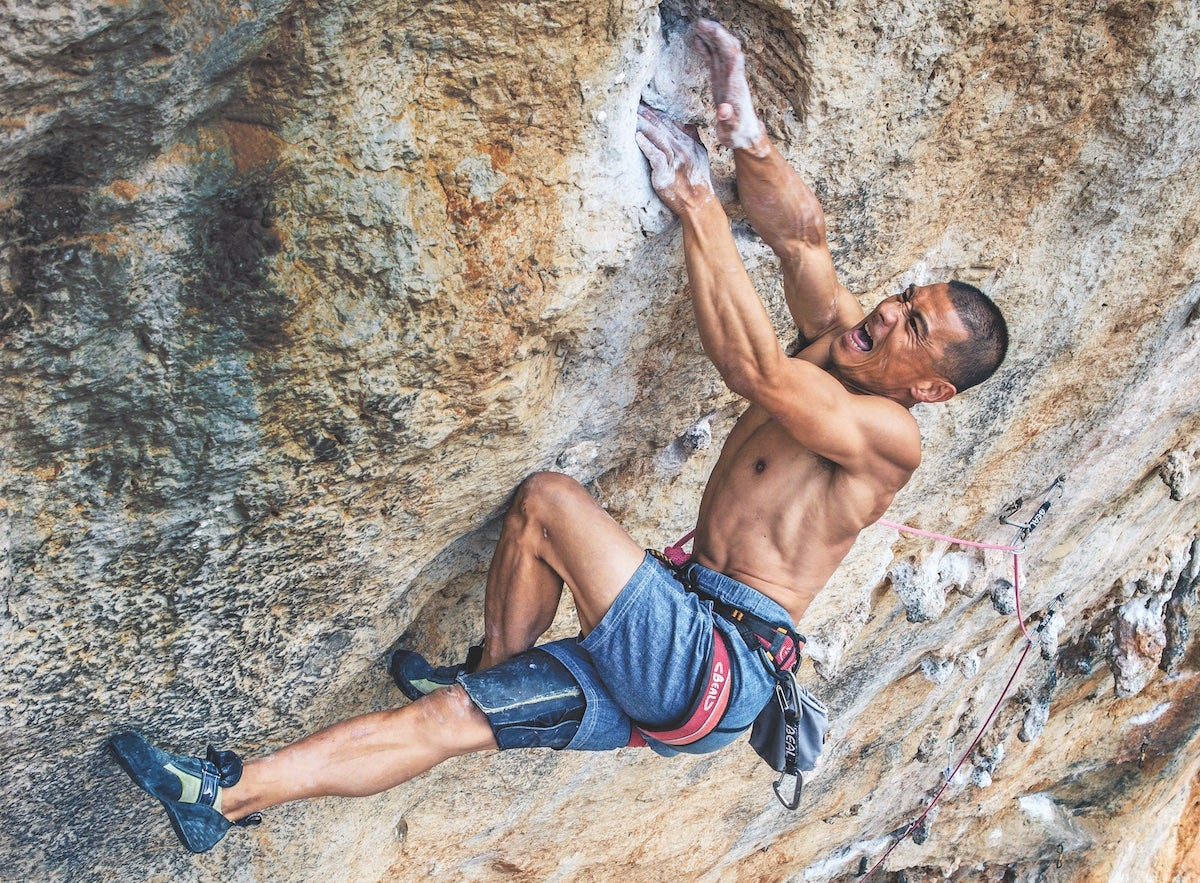
Yuji Hirayama cruxing out in Kalymnos (Photo: Eddie Gianelloni)
This interview originally appeared in Rock and Ice No. 266, published in November 2020.
On family.
My mom and dad ran a small factory. They worked 12 to 15 hours a day. I grew up seeing them like that every day and sitting down at a table together every meal. They taught me discipline to achieve something I want. If I wanted a tent, I worked in the family factory, then I could buy the tent. I could always ask my parents what I wanted to know. They taught me how to live and be a warm family.
On first climbing at age 15.
My first day of climbing had a big impact on my heart. I knew climbing would be forever for me. I imagined rock waiting all around the world. I couldn’t climb all of it, but I would follow the rock. I trained and trained to be ready to climb hard.
On competitions.
You can learn a lot by pushing your limit at the cliffs, but to push yourself at comps … you have to perform with the right decisions at the right moments.
ADVERTISEMENT
In 1990 François Legrand [later multiple world champion] and I trained very, very hard. We climbed at the cliff during the day, and after that we trained at home till 1 or 2 a.m. It was not the right idea for me. I was so tired every day. But maybe for François it was a good way!
On the only onsight of the Sphinx Crack (5.13c, closed to the public since 2006) in South Platte, Colorado, in 1995.
It showed me my unique mix of skills … serious U.S. trad, also European sport and comps. I thought I could mix all those skills and create something new. Onsighting Sphinx Crack was the idea to try to onsight the Salathé (VI 5.13c, 35 pitches) in 1997.
On the Salathé, best onsight attempt until 2018, when Adam Ondra was no falls to the headwall. (Ondra, in a one-day attempt, fell on the first headwall pitch, then on his second go fell almost at the anchor. With “No more energy to give another try,” he retreated.)
I fell three times. First at Teflon Corner … then I onsighted the Huber variation. Second fall, start of headwall pitch. Third fall, second pitch of headwall. Second go, I sent it [and completed the route, in two days]. I learned a lot. When I came back from El Cap, I thought I can be better in comps, also at the crag. …The Salathé increased my focusing level, my fighting level, and my ability to negotiate rock.
On onsighting and downrating Mortal Kombat, at Castillon, France, the first 8c/5.14b onsight, in 1999.
I downrated it [to 8b+/5.14a] because it was my true feeling, and I guess I just wanted to be honest.
ADVERTISEMENT
On world’s first 8c/5.14b onsight, White Zombie, Baltzola, Spain, 2004.
I trained to build up physical condition, from explosive power to long endurance, and transition the focus to skill and adaptation on the rock. For onsighting … I started from 5.13, and day after day I challenged [myself with] harder routes.
On FA of Flat Mountain, Futagoyama, near Tokyo, 9a+/ 5.15a, in 2003.
I traced the line in 1989 but I couldn’t imagine [it] realistically. Then I moved to France for seven years. … When I jumped on this line in 1999 my imagination was totally clear to do it. But it takes time. I tried seriously in 2002 and 2003, and finally my imagination came true.
On three Nose (El Capitan) speed records with Hans Florine.
It’s kind of a fun game. I’m so happy and proud to make something with Hans. I learned his skill of speed and the details from him. Team effort makes a special kind of satisfaction.